Roseville, CA · Garage Door Service
What Actually Happens When We Come Out
A look at what our techs check on a Roseville service call, built around homes from 1962-2007 and the valley heat that wears out garage door parts faster than people expect.
- Repairs & new doors
- Springs & openers
- Serving 6 nearby communities
Checking It Yourself
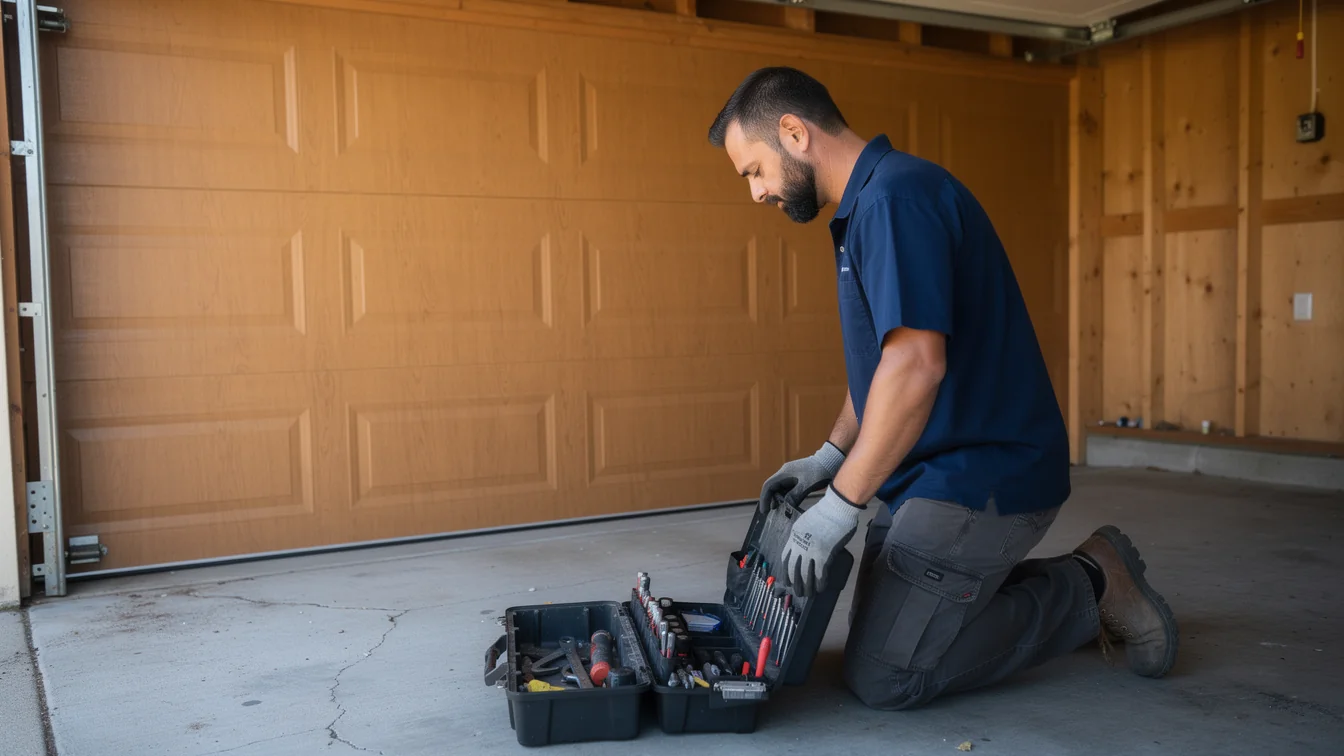
Before you call anyone, there's a short list worth running through. Pull the manual release and move the door by hand - it should lift with one hand and hold position halfway up. If it slams down or you can't budge it, a spring has lost tension or broken, and that's not a DIY fix. Look at the tracks for dents or gaps where rollers have jumped. Check the weatherstripping along the bottom panel; in a lot of Roseville homes built in the 1962-2007 window, that seal has baked and cracked from years of summer heat against a west or south-facing driveway. Listen for the opener motor running longer than it used to, or grinding before the door moves - that's usually a worn drive gear, common once an opener passes the fifteen-year mark. None of this tells you exactly what's broken, but it tells you whether you're dealing with a five-minute lube job or something that needs a torsion bar clamped and a spring swapped under tension, which is where DIY stops being worth the risk.
What Is Going On
Most of the housing stock we work on dates to between 1962 and 2007, with a lot of it clustered in the 1980s and 90s across the named subdivisions on this side of town. That means steel torsion springs rated for a certain cycle count, many of which are now well past their expected lifespan even if the door still looks fine from the driveway. Galvanized spring coating from that era doesn't hold up the same way current coatings do, and repeated expansion in severe summer heat speeds up fatigue in the coil. Nylon rollers from original builds get brittle under UV and heat exposure and start cracking at the hub, which shows up as a rhythmic thump every time the door cycles. Opener logic boards from the 1990s-era installs also tend to fail from heat-cycling inside an attached garage that runs hotter than the rest of the house all summer. None of this is dramatic - it's slow wear from a specific climate working on a specific generation of hardware, which is a different problem than a door installed five years ago would have.
When It Stops Being a DIY Job
A broken torsion spring on a standard double door is the clearest line. The spring is wound under several hundred pounds of tension, and the tools to safely unwind and replace it aren't something most homeowners own or should buy for a once-a-decade repair. Bent track, especially near the bottom roller brackets, is another one - forcing a door back onto a bent track usually bends it worse and can pop a cable off the drum. If the opener's logic board is failing intermittently, swapping parts without diagnosing the actual fault just burns money on guesses. And if the door is original to a 1960s-80s build and the springs, rollers, and opener are all original too, replacing one part is often a short-term patch before the next part fails. We'll tell you when that's the case rather than quote you a spring job that just buys you another six months.
What Local Conditions Do
Severe summer heat is the single biggest factor in what we see on service calls in this area. Garages here regularly sit well above outside air temperature by mid-afternoon, and that heat load hits springs, plastic rollers, opener electronics, and even the glue on insulated panel doors. Steel expands and contracts daily through the hottest months, and over a few decades that cycling fatigues metal faster than it would in a milder climate. It also means lubricant breaks down and dries out quicker than the twice-a-year schedule people assume is enough - in this heat band, more like three or four times a year keeps rollers and hinges from running dry. Across the roughly 92,784 owner-occupied houses in the service area, we see a consistent pattern: original hardware from the 1962-2007 construction era failing earlier on the hottest-exposure driveways, and holding up longer on doors with more shade or a north-facing garage.
Frequently asked questions
How often should I have my garage door serviced in Roseville?
Given the heat here, we'd lean toward checking springs, rollers, and opener function once or twice a year rather than waiting for a failure. Homes from the 1962-2007 era especially benefit from this since original hardware is now decades into heat-cycling wear.
Why did my spring break with no warning?
Torsion springs fail by fatigue, not by sudden damage, and severe heat accelerates that fatigue. A spring can look fine on the outside right up until the metal gives out, which is why there's rarely a warning sign beyond the door starting to feel heavier.
Do you work outside Roseville itself?
We cover the surrounding service area, including Antelope, Diamond Oaks, Foothill Farms, Orangevale, Carmichael, and the other named areas within roughly 20 miles, alongside Roseville proper.
Is it worth repairing an original door from the 1980s or 90s?
Sometimes. If the panels and track are sound and only the spring or opener has failed, a repair makes sense. If multiple original parts are failing together, we'll tell you honestly when a full replacement costs less over time than repeated repairs.
Related garage door services in Roseville
More garage door guides
Book garage door service in Roseville
Call now or request a quote - tell us what the door is doing and where you are.