Roseville, CA · Garage Door Service
Buying a Replacement Garage Door in Roseville
Roseville homeowners weighing a new garage door against another repair: what the area's 1962-2007 housing stock and summer heat mean for the decision.
- Repairs & new doors
- Springs & openers
- Serving 6 nearby communities
Checking It Yourself
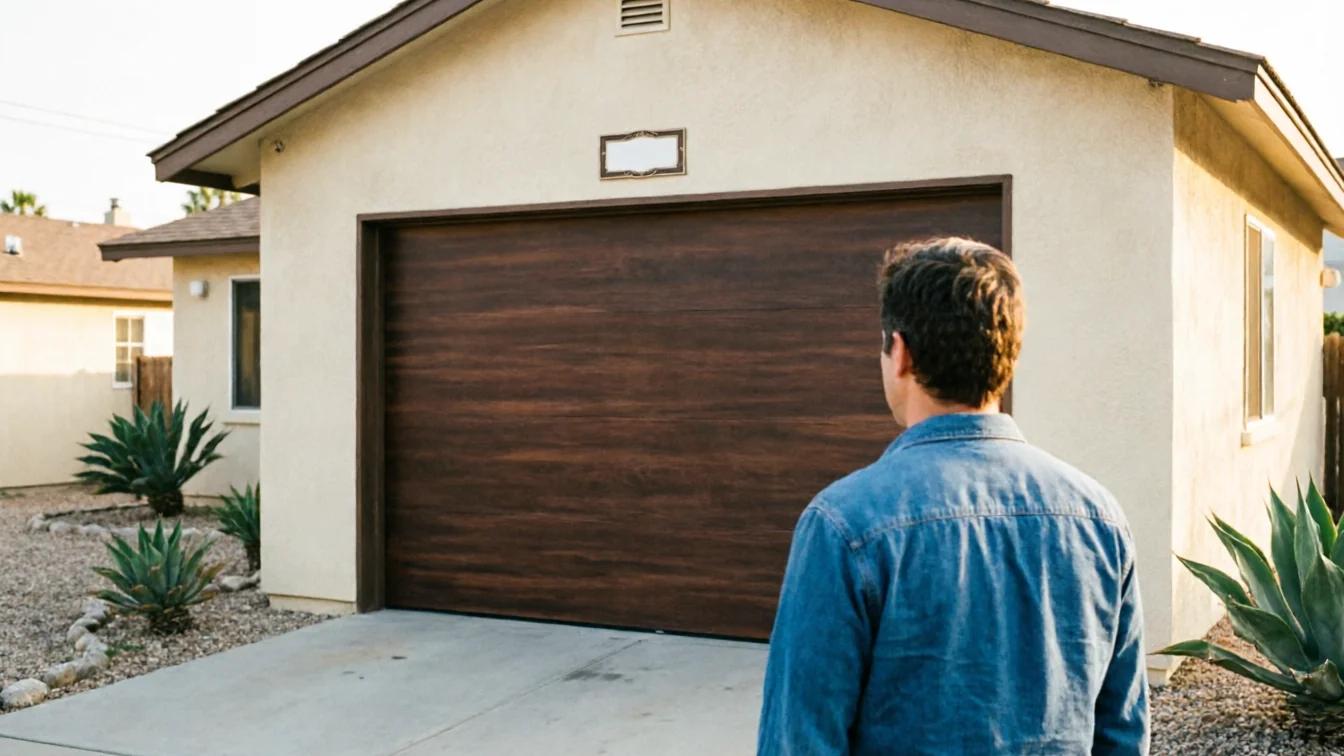
Before you call anyone, walk your door through a few checks. Pull the release and lift the door by hand, slow, with both hands. If it's heavy, uneven, or drops on one side, that's a spring problem, not a panel problem. Look at the bottom panel and the weatherstripping along the base - in a lot of Roseville homes built in the 1962-2007 window, that seal has baked and cracked from repeated summer heat and nobody's replaced it since the house was built. Check the tracks for rust or bent spots, especially near the bottom rollers, and look at the panels themselves for warping. Steel doors from the 1970s and 80s weren't built with the insulation standards used today, so if yours has never been replaced, you're likely looking at a single layer of steel that's had 30-plus summers to expand and contract. None of this requires tools beyond a flashlight and a ladder. What it does require is honesty about what you're seeing: a door that's merely noisy is a different job than a door that's bowed, rusted through, or won't stay up on its own. Write down what you find before you decide whether this is a repair call or a replacement one.
What Is Going On
Most of the housing stock around Roseville went up between 1962 and 2007, with the median landing around 1981, and that matters more than people think. A door installed when a house was built in 1981 is now well past the point where springs, rollers, and hardware are original - if they haven't been swapped out already, they're overdue. Across the 28 named areas that make up this broader stock, the pattern repeats: 1980s and 90s construction, single-layer steel doors, torsion or extension springs rated for a load that's changed as panels sag and hardware wears. Add in a climate band the federal data marks as severe heat, and you get a second problem layered on top of age - steel expands during the day and contracts at night, seams loosen, and non-insulated doors transfer heat straight into an attached garage, which some owners don't notice until they're standing in it in July. So when a door starts sticking, scraping, or running rough, it's rarely one thing. It's usually old hardware meeting heat-stressed material at the same time, and that combination is why repairs that used to hold for years start failing every few months instead.
When It Stops Being a DIY Job
Springs are where I draw a hard line. A torsion spring under tension can break a hand or worse, and I won't walk a homeowner through replacing one over the phone - that's not false modesty, it's just not a job for someone doing it once. Same with cables under load. If your check turned up a broken spring, a frayed cable, or a door that's come off its track, stop and call someone; don't force it open with a pry bar.
The replace-versus-repair line usually comes down to math, not drama. If the door itself is original to a house built in the 1960s through the 1980s, and you're now looking at a second or third spring replacement plus rollers plus a bowed panel, you're spending repair money on a door that's going to need the same attention again in a year or two. At that point a new door, properly insulated for the heat this area sees, often costs less over five years than another round of patch repairs on steel that's three or four decades old. I'll say plainly: if your door is newer, or the damage is isolated to one panel from a backed-into-it kind of hit, repair is usually the right call. I won't talk you into a full replacement you don't need.
What Local Conditions Do
The climate factor here isn't abstract - this area sits in a federally marked severe heat band, and that shows up directly in garage doors. Non-insulated steel doors, common in the 1980s and 90s builds that dominate this stock, don't just look worn after enough summers; they warp slightly at the seams where repeated heat cycling has worked the metal. An insulated door handles that cycling better and keeps summer heat from radiating straight through to an attached garage and the rooms next to it.
The service area itself is large: roughly 219,697 households and about 92,784 owner-occupied houses spread across places from Antelope and Foothill Farms a few miles out to Rosemont, Mather, and West Sacramento further on. Median household income across that area runs $95,592, which is relevant mainly because it tells you this isn't a market where cheap, short-lived doors make sense long-term - most owners here are better served buying once and buying a door rated for the heat, rather than replacing a budget door twice in a decade.
Frequently asked questions
Is it worth repairing an old door instead of replacing it?
Sometimes. If the damage is one panel or a single broken spring on a door that's otherwise sound, repair is usually cheaper and faster. If you're on your second or third spring replacement on a door original to a house built decades ago, you're likely spending repair money on a door that needs replacing anyway.
Why does my garage door seem worse in summer?
This area sits in a severe heat band, and steel doors expand and contract through daily heat cycles. On older, non-insulated doors common in 1980s and 90s builds, that cycling loosens seams and dries out weatherstripping faster than it would in a milder climate.
Can I replace a torsion spring myself?
I wouldn't recommend it. A torsion spring holds real tension and can cause serious injury if it lets go while you're working on it. That's one job I tell homeowners to leave to someone who does it regularly, not something to learn on your own door.
Related garage door services in Roseville
More garage door guides
Book garage door service in Roseville
Call now or request a quote - tell us what the door is doing and where you are.