
Roseville, CA · Garage Door Service
How Roseville's Climate and Older Doors Team Up to Cause Drafts
Roseville homes built mostly in the 1980s face summer heat that wears door seals fast. Here's how to spot a bad seal before it costs you a service call.
- Repairs & new doors
- Springs & openers
- Serving 6 nearby communities
Checking It Yourself
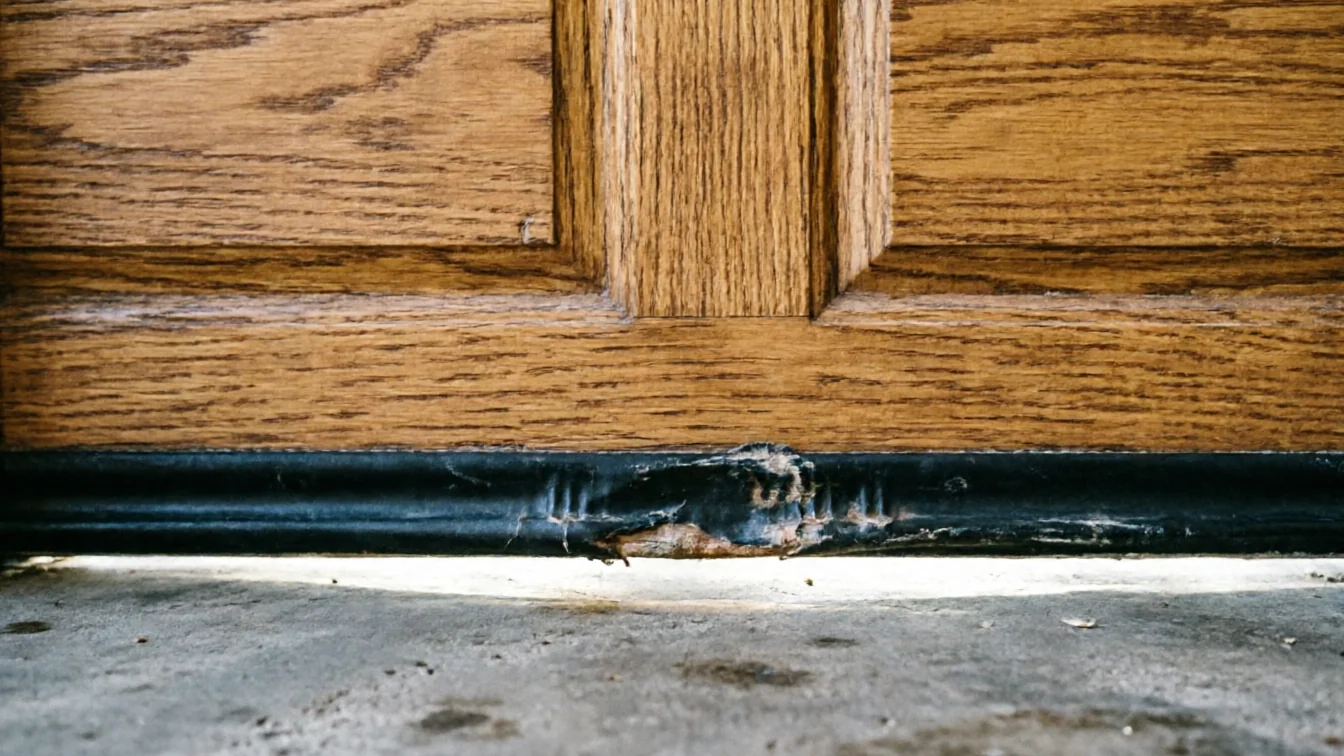
Start at the bottom panel. Most houses around here went up between 1962 and 2007, with the bulk of that stock dating to the 1980s and 90s, so the bottom weatherstrip on your door is probably the original style gasket set into a metal retainer, not the newer bulb-style seal. Pull the garage door down and look along the floor line with a flashlight off. If you see daylight at the corners or feel air moving across your ankles, the seal has hardened and shrunk away from the slab.
Check the side seals next, the strips tacked to the jamb that the door closes against. On doors from this era they're often just a single flat strip of vinyl, and years of summer heat bake that vinyl brittle. Press a thumb into it - if it cracks instead of flexing back, it's done.
Last, run a hand along the top seal where the door meets the header. A worn top seal is the one owners miss most, because the gap is small and drafts there get blamed on the opener or the attic instead of the door itself. None of this takes more than ten minutes, and it tells you whether you're looking at a $30 strip replacement or something bigger.
What Is Going On
Rubber and vinyl weatherstripping breaks down from UV exposure and heat cycling, and this area sits in a severe heat climate band, which means the seals on an average Roseville garage door spend more hours per year at high surface temperature than they were engineered for. The material doesn't fail all at once - it shrinks a little each summer, pulls away from its track, and eventually cracks at the stress points around the corners.
Because most of the housing stock here dates to the 1980s and 90s, a lot of doors are also still running their original aluminum retainer track for the bottom seal, a style that was phased out on newer installs because it holds the seal less securely once it starts to shrink. That combination - older retainer hardware plus three decades of heat cycling - is why drafts show up here as a seal problem more often than as an insulation problem.
A draft by itself usually isn't urgent. It's a comfort and energy issue, not a safety one, and it's the easiest fix on this list.
When It Stops Being a DIY Job
A cracked seal strip is a straightforward swap. What isn't straightforward is when the retainer track itself is bent, rusted shut, or was replaced at some point with a mismatched profile - common on houses in this area that have had one or two prior repairs done piecemeal over 40-plus years of ownership. At that point you're not buying a strip, you're buying a track, and getting the sizing right on an older aluminum profile can mean a part that isn't sitting on a shelf.
We'll say plainly: we don't stock every retainer profile for doors built in the 1960s through early 1980s, and matching one sometimes means a short wait on the part. That's the honest limit of a same-day fix on an older door.
If the draft comes with the door binding, scraping, or sticking partway through its travel, stop treating it as a seal issue. That's a track alignment or spring balance problem, and forcing a seal into a misaligned track just tears it again within a season.
What Local Conditions Do
The severe heat this area sees isn't just a seal problem - it's why sealing work here gets prioritized differently than it would somewhere with a milder year-round climate. A gap that costs a few dollars in summer air conditioning becomes real money over months of 95-plus-degree days, and that math holds whether the house sits closer to Blue Oaks or out toward Diamond Oaks.
Across the wider service area - roughly 92,784 owner-occupied houses out of 219,697 households total - the housing stock spans 28 named areas, but the core pattern repeats: doors installed when the neighborhood was built, seals that have never been swapped since, and heat doing slow damage every summer in between. That's the baseline we work from when someone calls about a draft rather than guessing at a one-size answer.
Frequently asked questions
Why does my garage door only draft on the hot side of the day?
Seals expand and contract with temperature. A strip that's already shrunk from years of heat cycling pulls back further once the sun hits that side of the door, opening a gap that closes up again once things cool off at night. It's a sign the seal has lost its flex, not that something is loose.
Can I just caulk the gap instead of replacing the seal?
You can, but caulk doesn't flex with a moving door and it'll crack out again within a season. The retainer-and-strip setup on most doors here exists so the seal can compress and release every time the door cycles - caulk fights that instead of working with it.
Is a drafty door worth fixing if the door still opens fine?
Usually yes, and it's cheap compared to most garage door work. The exception is if the retainer track is bent or rusted - then you're into parts that may need ordering, and it's worth having someone look at the whole track, not just the strip.
Related garage door services in Roseville
More garage door guides
Book garage door service in Roseville
Call now or request a quote - tell us what the door is doing and where you are.