Roseville, CA · Garage Door Service
Roller Replacement for Fair Oaks' Older Garage Doors
Fair Oaks homes date to a 1977 median build year, older than most of our service area. Steel rollers on steel track are common here. We travel from Roseville to fix it.
- Repairs & new doors
- Springs & openers
- Serving 6 nearby communities
Getting It Booked In
Fair Oaks sits about 9 miles from our Roseville shop, and the housing stock here runs older than a lot of what we see closer to home. The median year built in Fair Oaks is 1977, compared with 1981 across the wider service area we cover - not a huge gap on paper, but it matters for rollers. A door installed in the late 1970s was almost certainly fitted with steel rollers running in steel track, and in a house that's never had the garage door touched, those original rollers are still doing the job today, just loudly and with more friction every year.
When you call about a roller job in Fair Oaks, we ask what year the house was built and whether the door has ever been serviced. If the answer is "never," we already have a good guess at what we'll find before the truck leaves Roseville. We book the visit, bring stock that fits steel track hardware from that era, and don't waste a trip guessing at nylon rollers that were never there to begin with.
Fair Oaks has about 12,946 households, and a good share of them are sitting on doors from that same build window. That's not a coincidence - it's a planning note for us and for you.
What Can Go Wrong
Steel rollers on steel track wear two ways: the roller wheel flattens on one side from decades of the same weight riding the same arc, and the track itself grooves where the roller has worn a channel into the metal. Once the track is grooved, a new roller doesn't fix the noise - it just rides the same bad groove more quietly for a while.
The other failure mode in a 1977-era door is the roller stem. Original stems are often shorter and thinner than what gets installed today, and after years of expansion and contraction they can bend or seize in the bracket. A seized stem means the roller stops spinning and starts dragging, which chews up the track faster than normal wear would.
Heat plays a role too. This region sees a severe heat band through summer, and steel track expands in that heat every single day for months. Expansion and contraction cycles loosen the bolts holding brackets to the jamb, which lets the whole roller assembly wobble slightly off-plane. A door that's slightly off-plane wears its rollers unevenly, left side faster than right or vice versa, and that's a pattern we look for specifically on older Fair Oaks doors rather than assuming a straight wear-out.
How It Shows Up
The sound comes first, usually a grinding or rhythmic clunk that gets louder as the door nears the top or bottom of its travel - that's the flat spot on a worn roller hitting the track at the same point every cycle. If you've got a door that's been running since the late 1970s and it's never once been resealed or adjusted, that grinding is close to guaranteed rather than a maybe.
Second sign: the door hesitates or jerks at a specific spot, same spot every time. That's usually the grooved section of track catching a roller that's lost its smooth taper. Third: you can see daylight or gaps at the edge of a panel when the door's halfway open, meaning a roller has slipped partly out of track and the panel is riding crooked.
We don't push replacement on noise alone if the door is otherwise sound - sometimes it's a lubrication issue, not a roller issue, and we'll say so. But on a 1977 build with original hardware, by the time you hear grinding, the rollers usually are at or past the point where lubrication only buys a few more weeks.
How We Fix It
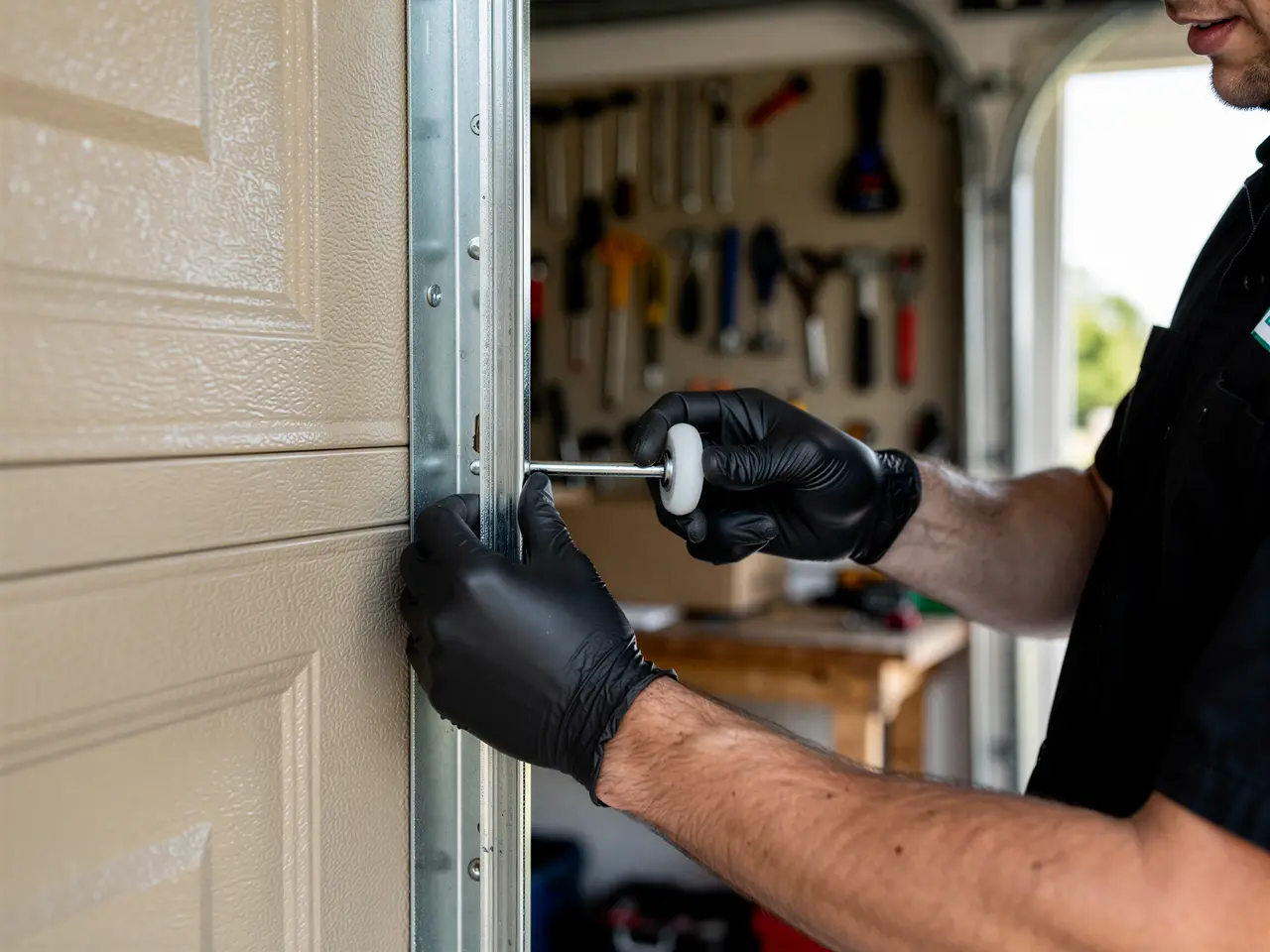
We pull the old steel rollers and stems and replace with rollers sized to the existing bracket spacing, since Fair Oaks doors from this era commonly use dimensions that don't match newer stock doors without some fitting. If the track itself is grooved beyond where a new roller rides smoothly, we tell you - a new roller in a bad groove will still grind, just differently, and swapping the roller without addressing the track is a job that doesn't hold.
We check every bracket bolt while we're in there, because the heat-cycle loosening we see in this area means a roller job and a bracket tightening often need to happen together, not as two separate calls. If your stems are seized rather than just worn, that usually means the whole hinge is due too, and we'll quote that honestly rather than stretch a roller fix to cover a bigger problem.
One honest limit: if the track is warped rather than just grooved, rollers won't solve it at any price - that's a track replacement job, and we'll say so on site rather than sell you new rollers that ride a bent rail the same way the old ones did.
Frequently asked questions
How do I know if my Fair Oaks garage door still has original rollers?
If the house was built in the 1970s and the door has never been serviced, the odds are high. Original rollers from that era are steel on steel track, not the nylon rollers common in newer builds. Grinding noise near the top or bottom of travel is the usual tell, along with visible flat spots on the roller wheel if you look closely.
Does the heat here affect how fast rollers wear out?
Yes. This area sits in a severe heat band, and steel track expands and contracts with it daily through summer. That cycle loosens bracket bolts over time, which lets the roller assembly shift slightly and wear unevenly. It's a slower failure than a single bad roller but it adds up over the decades a lot of Fair Oaks doors have been in service.
Do you have a shop in Fair Oaks?
No, we work out of Roseville and travel to Fair Oaks for jobs, about a 9-mile drive. We don't keep a branch or depot in Fair Oaks itself, but it's a regular stop on our route given how many older doors are still running original hardware there.
More garage door services in Fair Oaks
Book garage door service in Roseville
Call now or request a quote - tell us what the door is doing and where you are.